
SYMPOSIUM: FUTURE OF AMBIENCE, DUBROVNIK SUMMER FESTIVAL 18.07.2019.-20.07.2019.
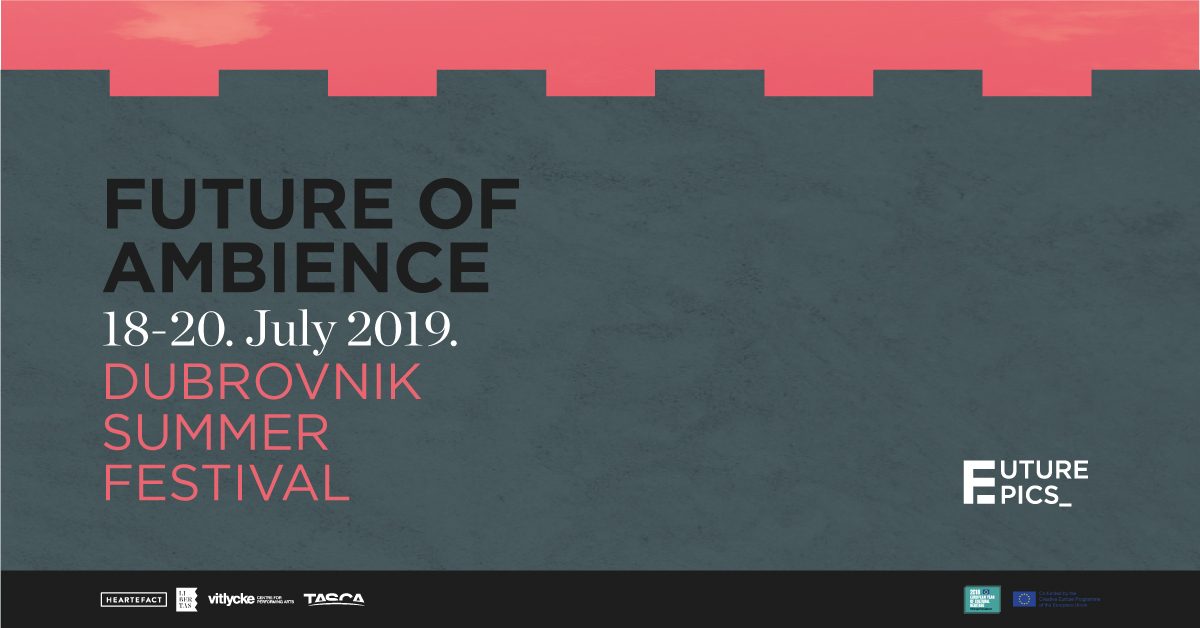
On the occasion of its 70th anniversary, Dubrovnik Summer Festival is organizing a symposium Future of Ambience, followed by the artistic program that explores site-specific approach, intertwining historical spaces and their imminent context with new media, experimental music and light installations. Future of Ambience is a program developed as a part of the Future Epics, project financed by Creative Europe programme. Its artistic part is co-produced by Art Workshop Lazareti.
www.dubrovnik-festival.hr
Symposium: Future of Ambience
DAY 1.
Braće Andrijića street
10:00
PART 1:
INTRODUCTION by DORA RUŽDJAK PODOLSKI, Artistic Director of the Festival:
Festival introduction & historical overview
Particularities of site-specific productions at Dubrovnik Summer Festival, once & today
Dora Ruždjak Podolski has directed around seventy theatre, musical and opera projects in Croatia and abroad. She teaches acting at the Zagreb Academy of Music and Zagreb Academy of Dramatic Art. From 2009 to 2012, she was appointed the Dubrovnik Summer Festival’s Theatre Programme Director. She directed several successful site-specific projects at the Festival. She has been appointed the Artistic Director of the Festival by the Croatian Minister of Culture in 2017.
10:30
PART 2: Dubrovnik-history of site-specific theatre: Culture as a driving force behind city development
Conversation with Paolo Magelli, Ivica Kunčević and Ivica Prlender with video presentation moderated by Saša Božić
Paolo Magelli was born in Prato, in the heart of Tuscany. His artistic development was greatly influenced by his teacher Giorgio Strehler, whose assistant Magelli was. Along with Roberto Benigni, Pamela Viloresi and Marcello Bratoli he became one of the founders of “Teatro studio del Teatro Metastasio” at the beginning of the 1970s. There they studied cultures that were less known to the public. Magelli directed on almost all stages in ex-Yugoslavia, Germany, Switzerland, Belgium, Italy, South America, Hungary, Israel. He won many international theatre awards. He has been the headmaster of “Teatro Stabile della Toscana” since 2010 and associate professor at the Drama Academy of the Zagreb University, department Theatre Director.
Ivica Kunčević is a theatre director who was serving as Dubrovnik Summer Festival Theatre Programme Director from 2002 until 2009. From 2008 he has been a professor at the Academy of Dramatic Art at the University of Zagreb. He has staged more than hundred theatre plays. In 2012 he published the book Dubrovnik Site-Specific Theatre.
Ivica Prlender is a historian, set designer and a professor at the Faculty of Humanities and Social Sciences of the University of Zagreb. His speciality is the history of Dubrovnik and Medieval history of Eastern Europe. He has served as Artistic Director and Executive Director of the Dubrovnik Summer Festival for 11 consecutive years.
Saša Božić is a Croatian theatre director and dramaturge present in the field of European contemporary dance. His interests lie mainly in the widening of the performing arts field – working on a thin line between theatre, dance and performance, examining the porosity of their frames, and the position of the performer within the disparate modes of performing. His works rarely fit neatly into the category of choreography or directing. His distinctive combination of movement materials, visual imagery and texts follows the transformations between his multidisciplinary roles as a choreographer, director and dramaturge. He was appointed Assistant to Festival’s Artistic Director for theatre programme in October 2017.
12:30
PARTICIPANTS’ QUESTIONS/COMMENTS
14:00
Lunch
20:30
Artistic Programme
BOJAN GAGIĆ: HAPPY PLACE
Interactive sound installation at Medieval foundry under Minčeta Fort
DAY 2.
Braće Andrijića street
10:00
PART 1:
Lecture: Citizans on Stage and Theatre at Home: On the City as Performance and co-producing Audiences in recent Productions of Rimini Protokoll
Lecture by Imanuel Schipper – Dramaturg and Performance Studies Scholar.
As 1% of your cities poulation you are asked to position yourself on the stage of the national theatre according to some statistical queries. In an other show, you are asked to come to a private living room in a neighbourhood you never have been and discuss with people you do not know about your perception of Europe. Sometimes you are led by an artificial voice through strange paths through your city or you turn a non-place into a performance hot spot. You never know what you are asked to do if you buy a ticket for a Rimini Protokoll Show. For almost 20 years the German-Swiss Collective is constantly pushing the borders of what theatre could mean and explores different ways of co-producing urbanity together with its audiences.
This talk will give an insight into some of the most recent productions of Rimini Protokoll with a special focus on the site-specific and urban aspects of their oeuvre. It will both present clips from the shows and give some theoretical context to the approach of productions like 100% City, Homesite Europe, Remote X or Parallel Cities.
Imanuel Schipper is a lecturer and researcher at different universities and art academies in Germany and Switzerland. He has been working as a dramaturg for the well-known German Performance group, Rimini Protokoll with whom, for 20 years, he has developed a contemporary way of documentary theatre as intervention, as political think tanks. Most recently he has been the dramaturg for „ State 1-4“ a tetralogy on post-democratic phenomena.
Imanuel Schipper works on the interface between scientific research, teaching, and artistic practice. His work seeks to analyse such terms as “theatricality“, “performativity“, “dramaturgy“, “staging“, “reception“ and “mediality“ – coming from the theatre studies – beyond the boundaries of the theatre, for example in design, urban design, scenography and curation. He holds a deputy professorship on Performance Studies and Dramaturgy at the Department Arts & Social Change at the Medical School Hamburg (MSH). He has been on the board of directors of Performance Studies international (PSi) and delivers his dissertation on “Relational Dramaturges” at Leuphana University Lüneburg.
11:30
PARTICIPANTS’ QUESTIONS/COMMENTS
12:00
PART 2:
Lectures: Heritage and movement
Simon Pons Rotbardt, programme manager at Centre des monuments nationaux
Heritage is often associated with a certain degree of inertia and sometimes rigid stereotypes. The Centre des Monuments Nationaux has decided to challenge this assumption by inviting movement artists to think about these new spaces of dissemination through the “Monuments en Mouvement” (“Monuments on the move”) operation. Circus arts, often relegated to the periphery or abandoned areas, are one of the key features of this operation, which is looking to provide these new forms with rich and elegant spaces. Dizzying heights, verticality, horizontality, new perceptions of space and the quirky discovery of monuments transform these dialogues between circus artists and heritage into special and unique moments that conquer new audiences.
These singular representations redefine the relationship with spectators, heritage and location, and offer the artists new playing grounds and new locations for experimentation. Collectif Protocole, but also Chloé Moglia, Jeanne Mordoj, Clément Dazin, Alexander Vantournhout at the Mont Saint Michel Abbey and Yoann Bourgeois at the Panthéon have been key figures in previous editions of “Monuments en Mouvement”.
After training in geography and theatre in Paris and Montreal, Simon Pons-Rotbardt turns to staging and thinks about new forms of representation, particularly in public spaces or to new play spaces. He is recruited in 2012 by the Center des monuments nationaux, France, to put in place a reflection on the development of performing
arts in heritage places; he creates under the impetus of Philippe Bélaval the operation “Monuments en movement”, national program of dance and circus that celebrated its fifth edition in 2019. With ‘Monuments on the move’, the Centre des Monuments Nationaux invites the public to rediscover France’s historic gems through the creations of up-and-coming and established artists from the world of dance and circus.
13:00
Lunch and Excursion to Lokrum island
21:30
Sponza Palace
Artistic Programme: Future of Ambience
IN MEMORIAM GEORGIJ PARO
Presentation of the book Georgij Paro’s City-Stage(Editor: Hrvoje Ivanković; Publisher: Disput, Zagreb) and premiere screening of the film Georgij Paro – Cleaning Up (Writer: Lada Džidić Barić; Director: Siniša Bajt; Produced by: Croatian Radio and Television)
In the period from 1971 to 1973, Georgij Paro directed Bertolt Brecht’s The Life of Edward II of England and Miroslav Krleža’s Aretheus and Christopher Columbus at the Dubrovnik Summer Festival, the three plays which can be considered a turning point in the history of the Festival theatre, as well as contemporary Croatian theatre, at least with regard to the ideas and achievements in the field of site-specific theatre. With Edward II, Aretheus and Columbus, Paro made a grand introduction of contemporary writers to the drama repertoire of the Festival, until that moment almost exclusively defined by productions of classical works, and the way he did it marked the beginning of a new chapter in consideration of the idea of site-specific theatre as a basic distinctive feature of the Dubrovnik Summer Festival’s drama programme. Apart from the new introductory study by Hrvoje Ivanković, the book Georgij Paro’s City-Stage contains around two hundred pages of texts by eleven other authors. The concept of the book was co-authored in his final months by Georgij Paro himself (1934-2018), one of the most significant directors in the entire history of Croatian theatre.
DAY 3.
Kaboga, Andrijica st.
09:00
Meeting of the partners of Future Epics project
12.00
Acoustics of Dubrovnik
Following the conversations, commentaries and performances from the archives of the Croatian Radio, a talk moderated by Iva Lovrec Štefanović
Iva Lovrec Štefanović (1964) graduated Musicology and Comparative Literature from University of Zagreb. Since 1988 she works at Croatian radio as journalist, author, host and producer of different radio shows and projects. She conceived more than 40 series of programmes in different radio formats and topics ranging from early music, music for film and theater, specialized programs for contemporary and electronic music, and music documentaries. She has produced and hosted (or commentated)numerous live concerts broadcastings, and some special concert projects in Studio Bajsić. Most important project is the series of live talk show programmes about Croatian music (Paths of Croatian Music, since 2000.) that was awarded by the Croatian Composers Society and Croatian Radio Television. She produces music documentaries since 2006., and from 2012. she launches series Oda-birano for adaptation of selected international programmes, but also produces
radioscapes of different formats as author and/or editor – some of them are noticed and nominated, and shortlisted or awarded on international radio festivals (New York Radio Festivals, Prix Europa, Prix Marulić.)
14.00
Lunch///Informal meeting of the partners of Future epics project ( if necessary)
20:30
Artistic Programme: Future of Ambience:
Hrvoje Hiršl: Spheres (Euclidian space)
Sound Installation at Bokar Fort
Hrvoje Hiršl is an Artist, Researcher and a Designer. His art projects are at the crossing of contemporary art and media art discourse. His main themes range from materiality of the art object, deconstruction of its aura and the limitations of the medium. In the last five years his interests shifted more into structures, automation and cybernetics. His work encompasses: sound installations, video installations, interactive installations, prints, etc.
In Euclidean space, objects are determined by three dimensions, the x-y-z coordinates. Spheres introduce discomfort into the space and seemingly distort it by changing their volume, positions and spatial relationships. Positioned somewhere between the multi-universe, spatial distortion and cybernetic bodies, they are unspecified bodies whose function is unknown but their presence leaves a mark in the space, bringing unrest, chaos and playfulness.
The number of the spheres is variable, depending on the size and position of the work in the space. The spheres are randomly placed in the space, unequally distant from each other, creating fields of blanks and clusters. They are pneumatic and they respond to visitors, like some exciting organic creatures, leaping in the air with an accompanying whistle when someone approaches them and tries to pass by them. They are connected by a system of rubber tubes to an air supply, that is, a compressor. A system of valves and sensors determines the order of their ignition and extinction, depending upon the presence of the visitors.
22:00
Artistic Programme: Future of Ambience:
The City Recites Držić at Libertina Caffe Bar
Interactive event hosted by Nataša Dangubić, Doris Šarić Kukuljica and guests at the Caffe bar Libertina
The bustling walled city of Dubrovnik hosts one of the oldest European festivals that annually, during 47 summer days from 10 July to 25 August, presents rich and vibrant theatre, ballet, opera, classical music, jazz, visual arts, film and folklore program. In 2019, the Festival will celebrate its 70th anniversary. Crucial for the success of this international Festival is its longevity and continuously high artistic standard, but also the Festival’s concept, which makes it different from numerous others. Unlike the majority of other summer festivals, the DSF doesn’t use open-air venues as mere visual attractions and only as sets. Space is decisive in creating a theatrical event, so the festival catalogue, during nearly seven decades of existence, comprises approximately 130 various site-specific venues! Festival believes that the City (including the residents) is a major co-creator of the Festival’s artistic product and that the artistic production is a matter of the deepest public interest. Festival has been a member of the European Festivals Association since 1956.
Recent Posts
-

Future Epics: Online residency program from 23th till 28th November
-
Ovation for “Intimacy” at 71st Dubrovnik Summer Festival
-
“Grižula” by Marin Držić, directed by Petra Hrašćanec and Saša Božić on 20th August on Dubrovnik Summer Festival
-
“Embrace” by Meleat Frederiksson scheduled for 17th August on Durovnik Summer Festival
-
“Intimacy” set to premiere at 71st Dubrovnik Summer Festival
Sign up for latest news and stories